
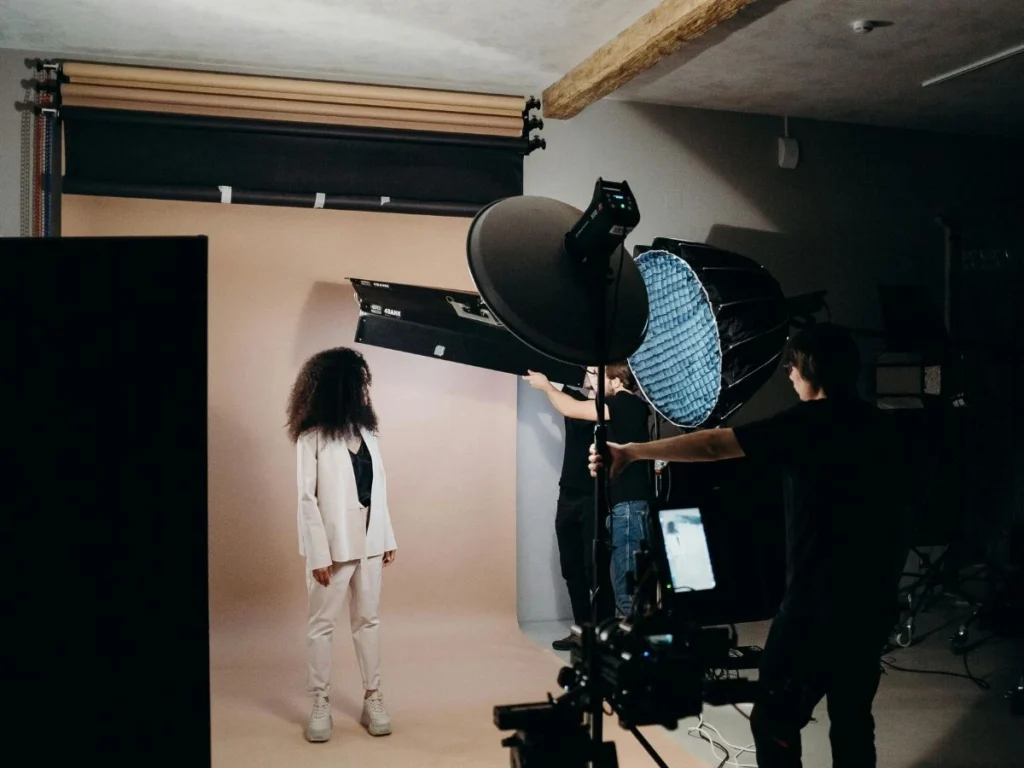
In a high‑stakes shoot, raw light straight from the source is rarely ready to use. It tends to spill everywhere, creating harsh hot spots and flattening skin tones. Lighting modifiers are the tools that turn that chaotic light into something controlled and intentional. By shaping beam angle, softness, and spread, they let you “sculpt” the light exactly where you need it. When you master modifiers like softboxes, grids, and reflectors, you spend less time guessing and adjusting on set. Instead, you get consistent, polished results from the very first frame, which speeds up the whole shoot. In this blog, we’ll look at the key lighting modifiers and how each one helps you work faster and more efficiently.
Lighting Modifiers: Expert Shooting Overview
Professional lighting modifiers serve as the essential bridge between raw, chaotic light and a polished, commercial frame. By utilizing tools like softboxes for uniform wrap and grids for spill control, creators can achieve consistent studio lighting control while eliminating the “guess-and-check” cycle on set. This technical mastery is vital for high-volume photography studios or when delivering mobile photography and videography services. Ultimately, these modifiers reduce post-production time by ensuring perfect exposure and “light hygiene” from the very first shot.
What Are Lighting Modifiers and Why Do They Matter?
Lighting modifiers in photography are any hardware designed to redirect, diffuse, or constrain the output of a light source. They are essential because they transform a chaotic, raw light source into a predictable and repeatable asset. By controlling the luminous flux and beam angle, these tools eliminate “light spill” that would otherwise muddy your background and force hours of corrective color grading. They ensure exposure consistency across the frame via internal baffles, which prevent “hot spots” and allow for a “one-and-done” setup in high-volume environments.
For professionals operating a photography studio in NYC, where space is often at a premium and light spill on nearby surfaces is a constant battle, these tools are indispensable for maintaining total control over the environment.
How do Lighting Modifiers Work?
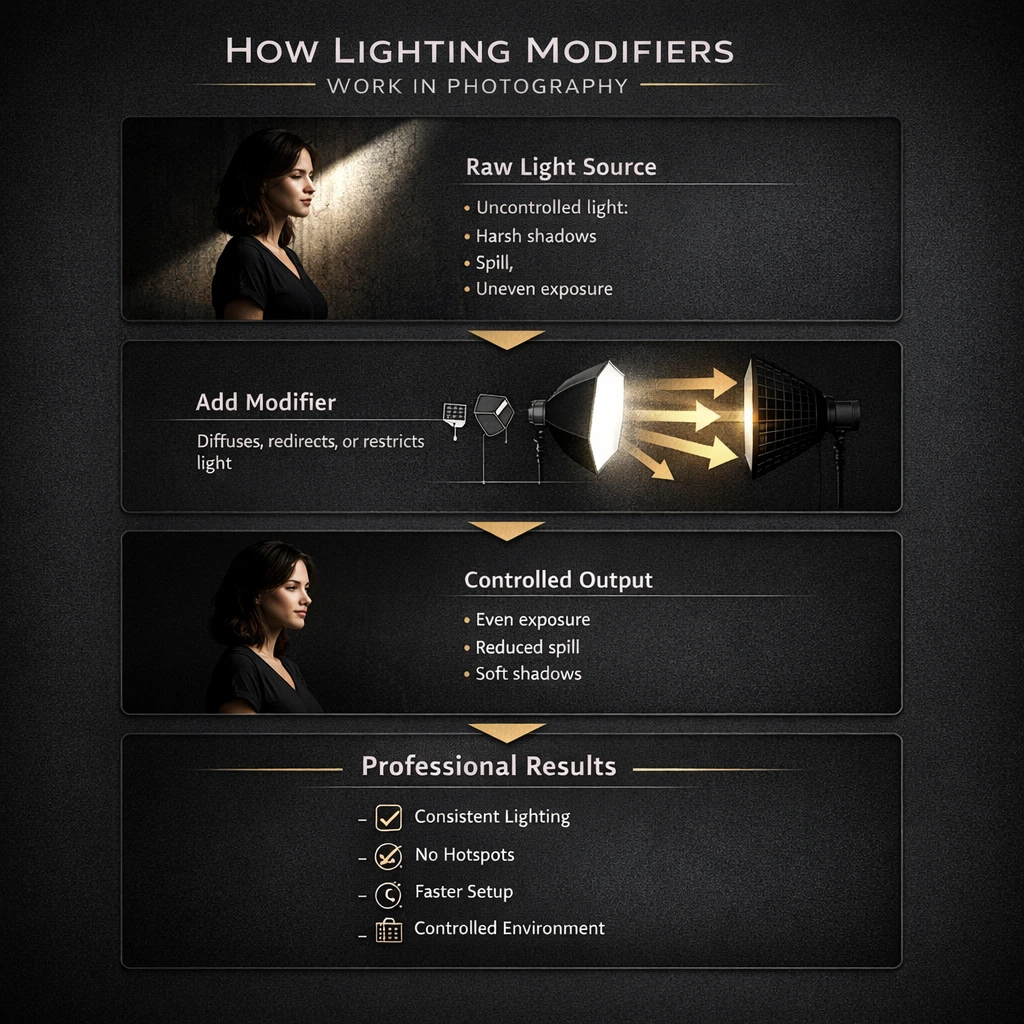
This infographic illustrates how lighting modifiers transform harsh, uncontrolled light into a precise and professional lighting setup.
Key Lighting Modifiers That Save Time on Set
Softboxes for Even, Predictable Light
Softboxes act as a controlled window, using internal baffles to neutralize the luminous hot spots of a raw strobe. For high-volume e-commerce or corporate headshots, a softbox is the ultimate time-saver because it creates a repeatable, uniform wrap. This level of studio lighting control means your exposure values remain constant across the frame, eliminating the need for individual exposure balancing in post-production. Whether using a 120 cm octa for portraits or a strip-box for rim lighting, the primary benefit is a “one-and-done” setup that requires zero micro-adjustments between shots.
Umbrellas for Quick Setup Shoots
Umbrellas are ideal for fast‑moving or on‑location shoots, such as event coverage, environmental portraits, or mobile photography and videography services. Unlike more complex modifiers that require time‑consuming assembly, a parabolic umbrella can be opened in seconds and is immediately ready to use, which is crucial when you’re working under tight schedules or in unpredictable settings. For top‑tier photography and videography services, this quick‑setup capability removes the technical downtime of assembling and adjusting multiple pieces of gear.
Reflectors for Rapid Light Balancing
Reflectors are a simple, cost‑effective way to add a second light without extra gear or power sources. In fast‑paced shoots, a 5‑in‑1 reflector lets you bounce ambient light into shadows instantly, using white or silver surfaces to balance the lighting ratio. This creates a more even dynamic range in‑camera and reduces harsh, clipped blacks or muddy shadows. As a result, you cut down on time‑consuming exposure fixes in post‑production while keeping the look natural and flattering.
Grids and Snoots for Precise Light Control
Grids and snoots give you laser‑like control over beam spread, with honeycomb grids (commonly 20°, 30°, or 40°) narrowing the angle of light and dramatically reducing spill. A snoot takes this further, creating an ultra‑narrow beam that behaves almost like a movable spotlight, perfect for isolating faces, products, or textures. By tightening the beam angle at the source, you maintain clean backgrounds, avoid lens flare, and eliminate the need for extensive masking or digital vignetting in post.
Conclusion
Now that you’ve seen how lighting modifiers shape speed, control, and image quality in a shoot. But buying and maintaining a full set of professional modifiers can be costly and complex, especially if you don’t shoot every day. If you’re looking for a rental studio that’s already equipped with everything you need, Grattan Studio is the solution. When you book our space, you get access to a full range of professional photo equipment included in the rental price, so you can walk in, set up fast, and start shooting with full studio lighting control from the first frame. Contact us today and step into a fully equipped, ready‑to‑shoot photo studio built for efficiency and creativity.
FAQS
How do you choose between silver and white interiors for your light modifiers?
Use silver interiors when you want brighter, more contrasty light with stronger highlights and a punchier, dramatic look. They are great for portraits, fashion, or situations where you want the light to “pop.”
Use white interiors when you want softer, more even light with smoother shadows and natural skin tones. They are better for beauty shots, interviews, or any setup where you want a gentle, flattering look without harsh highlights.
Can the same modifiers work for both photography and video?
You can use them for both, provided the modifier is rated for high-heat continuous use. Many strobe-only softboxes lack the ventilation required for COB LED video lights, which can cause the fabric to scorch or the light source to overheat during long shoots.
How does modifier distance change your shoot speed?
Moving the light source closer increases its relative size, which physically softens the shadows without needing a larger modifier. Understanding this inverse relationship allows you to adjust the “hardness” of your light on the fly by moving the stand rather than changing your gear.
What is the win with double-diffusion softboxes?
Double-diffusion uses an internal baffle to kill the “hot spot” from the raw bulb before it hits the outer layer. This ensures the light output is dead-even across the entire front face, which is vital for creating clean, professional reflections on shiny or metallic surfaces.
Does a 5-in-1 reflector beat a fixed fill light for outdoor shoots?
For high-speed, mobile sets, a reflector is often superior because it matches the sun’s color temperature automatically and requires zero batteries. It allows you to lift the lighting ratio instantly by harvesting existing sunlight, though a flash is more reliable when the ambient light is shifting.