

You’ve created the product. A well-developed formula, polished packaging, and reviews you’re genuinely proud of. Still, why isn’t it getting the attention it deserves? Why do potential customers hesitate, scroll past, or fail to connect, even when everything about the product checks out?
The issue often isn’t the product itself. It’s how the product appears online.
The competition is high. People scroll quickly, and somehow your brand keeps slipping behind a sea of lookalikes that all promise similar results. When visuals don’t instantly communicate quality and credibility, buyers move on. Here, you don’t have to panic. You can change that with the right clinical skincare product photography.
In the sections ahead, we’ll break down why this photography style matters, how it builds buyer trust, and how you can use it to present your skincare products with clarity and confidence.
Clinical Beauty Photography And Consumer Trust – At A Glance
Clinical high-key product photography uses controlled lighting, neutral backgrounds, and precise color management to present skincare products with visual clarity and consistency. This approach accurately represents packaging details, formulation tones, and texture transparency, helping reduce customer uncertainty and visual misinterpretation. By aligning imagery with compliance-sensitive claims and treatment-focused positioning, brands reinforce credibility across digital platforms. The blog also outlines practical techniques for managing reflections, exposure balance, focal length, and retouching to maintain realism while preserving a polished, professional presentation.
What Clinical High-Key Product Photography Means For Skincare Brands
Clinical high-key product photography is a bright, ultra-clean photography style used by skincare brands to create a sense of purity, science, and trust. It uses soft, even lighting, white or very light backgrounds, minimal shadows, and neutral color tones to give products a medical, dermatologist-approved feel.
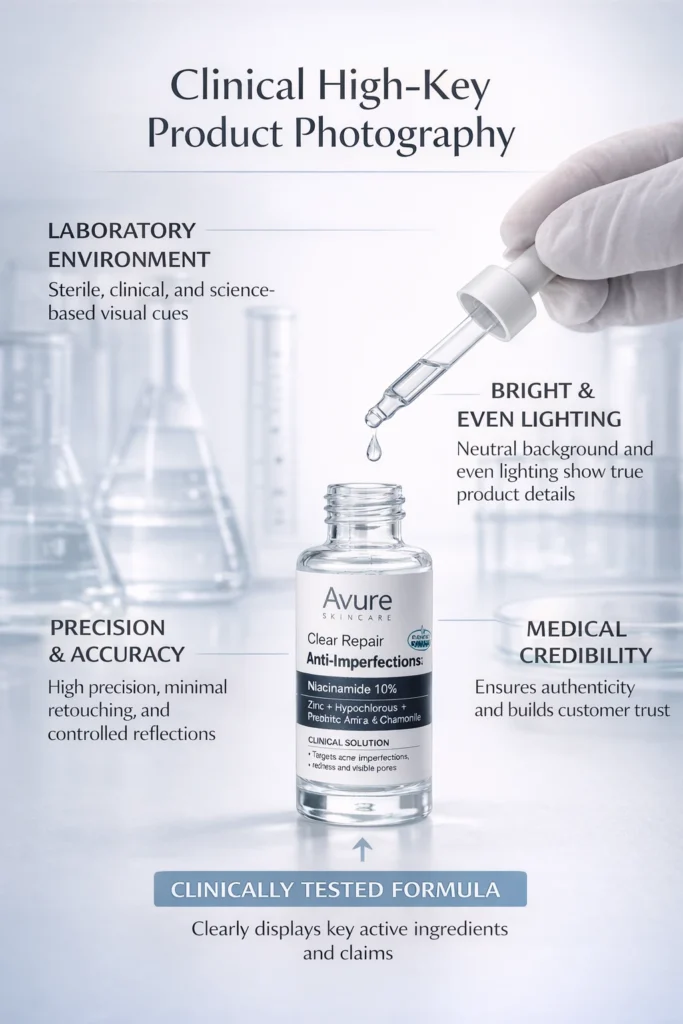
How Clinical High-Key Photography Strengthens Long-Term Brand Credibility
-
Reduces return rates caused by visual mismatch
When customers receive a product that looks different from its images, trust erodes. Beauty photography minimizes this risk by showing true packaging tone, label finish, and size perception. Brands that prioritize visual accuracy often experience fewer complaints related to “product not as expected.”
-
Improves ingredient and formulation credibility
Visibly clear gel-based skincare product(s) (gel, cream, tea, oil, wax) have been available in the marketplace for quite some time. Skincare product photography can accurately display the formulation’s color and consistency, so there is a visual confirmation for the ingredient-sensitive consumer that a vitamin C serum is stabilized and does not have an oxidized or discolored color when viewed under high-key lighting.
-
Supports compliance-focused marketing claims
Statements including “dermatologist-tested,” “non-comedogenic,” and “clinically proven” all need to reflect the seriousness of those claims by having the product image represent the same discipline as the evaluation and/or testing of the product, rather than the lifestyle portion of the product. Using a clinical photo lighting setup is beneficial for the clinical claims by visually linking the product to the evaluation/testing process rather than the lifestyle portion. This is especially important in highly regulated areas where exaggerated images may be of concern to regulators concerning compliance issues.
-
Increases trust in problem-solution products
Skincare aimed at acne, rosacea, eczema, or aging is purchased cautiously. Customers scrutinize these products more than general cosmetics. Clinical vs lifestyle photography positions the product as a solution tool rather than a beauty accessory, helping buyers feel the brand understands skin concerns as conditions, not trends.
-
Enhances cross-platform consistency without quality loss
High-key images retain clarity when resized for e-commerce thumbnails, mobile screens, and marketplace listings. Unlike moody or contrast-heavy images, details do not disappear when compressed. This consistency ensures the product looks reliable whether viewed on a large website banner or a small product grid.
Professional Tips To Attain High-Key Product Photography Skills For Skincare Brands
- Create even lighting before increasing exposure: Place one large diffused light at a 45° angle to the product. Similarly, add a second light on the opposite side at a lower power. Now, take test shots and check that no side appears darker. Only once the light is balanced should you raise exposure to achieve the high-key look.
- Light the background separately from the product: Make sure you are keeping the product at least 2–3 feet away from the background. Use one or two lights aimed only at the backdrop to keep it bright, while keeping product lights softer. This prevents edges from blending into the background.
- Control reflections using light placement, not extra lights: For glass bottles or glossy caps, rotate the light source around the product instead of adding more lights. Use vertical softboxes or strip lights to create clean reflection lines. Adjust angles until glare disappears from labels.
- Lock color accuracy using manual settings: Set your camera to manual white balance and use a gray card at the start of each shoot. This will help you maintain the same lighting temperature throughout the shoot so that the colors of the packaging and the formulas are accurate.
- Shape soft shadows to ground the product: Use a white reflector. Place it below or behind the product to soften shadows instead of removing them. If shadows appear harsh, move lights farther away rather than increasing diffusion.
- Use the correct focal length for product proportions: Shoot skincare bottles and jars with a 50–100mm lens (full-frame equivalent). Position the camera at the product’s center height to avoid distortion and maintain natural proportions.
Conclusion
Now that you are aware of how your brand can build trust, you can start creating and applying these principles in your product images and videos. If you still need help with the setup, you can book a photo studio space at Grattan Studios. We provide a fully equipped studio space and professional lighting tools. It gives your team the environment they need to create clean, credible visuals without compromise.
FAQ’s
Is Clinical High-Key Imagery More Effective in Skincare Paid Ads?
Bright, white-dominant graphics provide visual respite in cluttered feeds. Their crisp contrast enhances scroll-stopping power, particularly for products with a treatment focus, by standing out against darker, lifestyle-heavy content.
Can Clinical Product Photography Be Done In-House or Should Brands Hire a Studio?
It Depends. If you have the appropriate lighting, a stable environment, and someone who understands the concepts of exposure, reflections, and colour accuracy, then clinical product photos can be produced in-house. However, if you are launching a line, targeting a premium position, or need marketplace-ready images of the highest quality, a professional beauty product photography studio will normally result in a much cleaner and more consistent photo.
What Background Materials Are Used in High-Key Beauty Photography?
Photographers usually use white seamless paper for a clean, shadow-free background. Acrylic sheets give the ability for slight reflection to accommodate the subtle nature of this type of image. The use of foam core boards and PVC panels can help to assist with evenly bouncing light across the subject. Premium shoots often use a custom white staging setting when a perfect clinical look is desired.
Is Clinical High-Key Photography Suitable for Reels and Short-Form Video Content?
Definitely, this style of photography can be produced into short videos and reels due to the bright white background we use in our imaging, which allows the product to be the main focus. The main difference when shooting in this manner is that adjustments will need to be made to your lighting because of the added movement of the video; this will help you eliminate flicker and overexposed images.
How Often Should Beauty Brands Update Their Product Photography?
Ideally, every 12 to 18 months, beauty brands should update all their product photography, unless there is an update in branding/packaging, formulation, or overall visual strategy; in which case, updates should happen sooner. In addition, it’s recommended to refresh your imagery whenever launching new campaigns, entering new marketplaces, or redesigning your website.
